 1300 71 61 41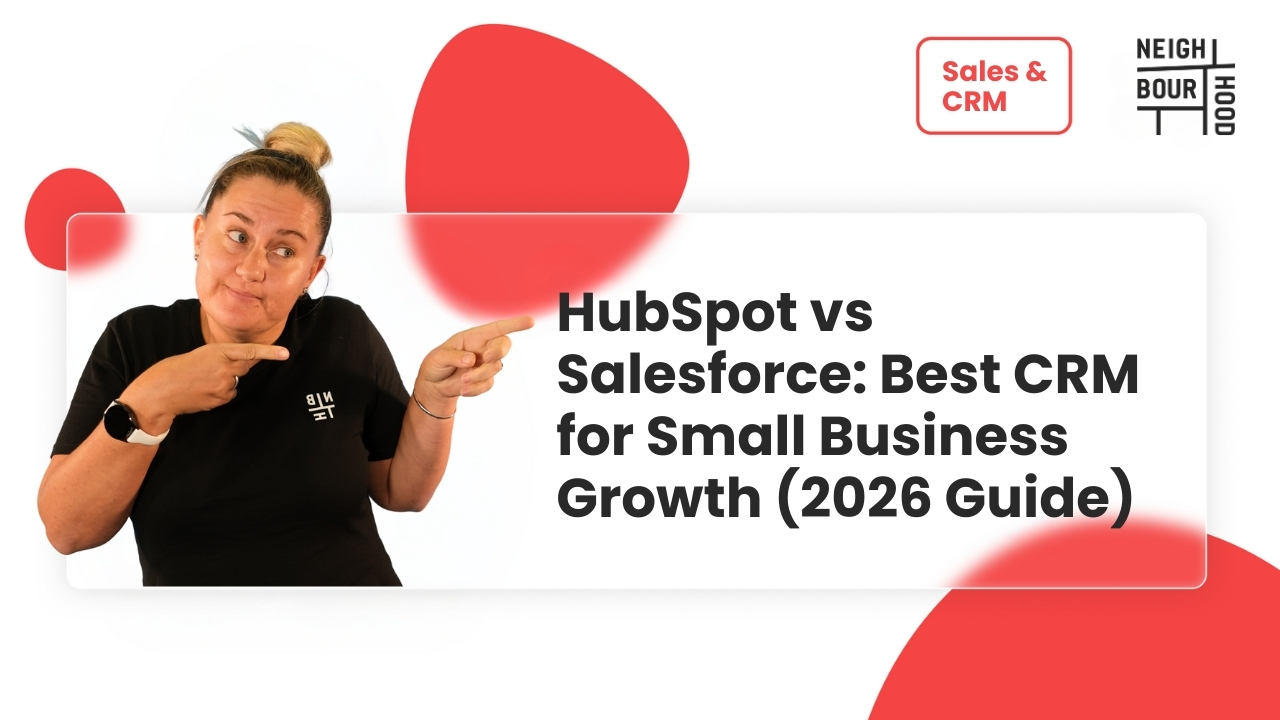
Choosing a CRM is no longer a “systems” decision. For SMBs, it’s a growth decision. Your CRM shapes how your teams work, how customers experience your brand, and how predictable your revenue becomes.

HubSpot and Salesforce dominate the CRM conversation. Both are powerful. Both are proven. But they are built with very different assumptions about resources, complexity, and speed to value. For SMBs balancing growth ambitions with limited time, budget, and internal ops capacity, those differences matter.
This guide breaks down HubSpot vs Salesforce through a business-first lens, with a clear bias towards what actually works for SMBs. Not feature lists for feature lists’ sake, but outcomes, adoption, and long-term impact.
Why CRM Matters More Than Ever for SMBs
A CRM isn’t just a database. It’s the system that connects:
- Marketing activity to revenue
- Sales conversations to real customer context
- Customer support to retention and expansion
For SMBs, the payoff is clear when implemented well:
- Better visibility across the funnel
- Faster response times
- More consistent customer experiences
- Clearer reporting for leadership decisions
When implemented poorly, a CRM becomes shelf ware, creates friction, and quietly drains budget. The real question isn’t “which CRM is most powerful?” It’s which CRM your team will actually use and grow with.

The Contenders: HubSpot CRM vs Salesforce CRM
HubSpot CRM: Built for growth without complexity
HubSpot is designed around one core idea: remove friction between teams so businesses can grow more efficiently. Its CRM sits at the centre of an integrated platform covering marketing, sales, service, operations, and AI.
For SMBs, the key advantages are:
- Fast time to value
- Intuitive user experience
- Strong native marketing and sales alignment
- A free CRM that scales as you grow
HubSpot’s approach is modular but connected. You add power when you need it, without rebuilding your entire system.
Salesforce CRM: Enterprise-grade power and flexibility
Salesforce is an established CRM platform globally and is known for its deep customisation and scalability. It excels in environments with:
- Complex sales processes
- Heavy compliance or data requirements
- Dedicated admins or IT resources
Salesforce can do almost anything. The trade-off is that it usually requires more configuration, more training, and more ongoing management to get real value.
What SMBs Actually Need from a CRM
Before comparing features, SMBs need clarity on outcomes. The wrong CRM choice usually comes from skipping this step.
Business goals first, software second
Ask:
- Do we need better lead generation and marketing attribution?
- Do we need cleaner pipelines and forecasting?
- Do we need to improve onboarding, retention, or support?
HubSpot tends to suit SMBs where growth is driven by marketing and sales alignment. Salesforce often suits businesses where process complexity is the dominant challenge.
Adoption beats sophistication
A CRM only works if your team uses it daily. HubSpot’s interface is intentionally simple, which reduces training time and increases adoption. Salesforce’s flexibility means user experience can vary widely depending on setup, which often requires more training and internal support.
For SMBs, speed of adoption is often more valuable than maximum configurability.
Budget is more than licence fees
Both platforms use tiered pricing, but total cost of ownership matters more than the headline number.
Common Salesforce cost drivers for SMBs include:
- Implementation partners
- Custom development
- Ongoing admin or ops support
HubSpot’s bundled model and native features often result in lower implementation overhead and more predictable costs, especially for lean teams.
HubSpot: The All-in-One Growth Platform for SMBs
Inbound-first, built for real teams
HubSpot’s inbound philosophy focuses on attracting the right customers, not just managing records. That shows up in how the platform connects content, campaigns, pipelines, and customer history without requiring heavy configuration.
Sales Hub: cleaner pipelines, better focus
HubSpot Sales Hub helps SMB sales teams:
- Prioritise the right deals
- Automate follow-ups
- Reduce manual admin
- Improve visibility across stages
It’s designed to support how SMB sales teams actually work, not how enterprise sales teams report.
Marketing Hub: where HubSpot pulls ahead for SMBs
Marketing Hub is a major differentiator. SMBs can manage:
- Email marketing
- Landing pages and forms
- Lead nurturing
- Attribution, reporting and analytics
All natively connected to the CRM. This tight integration is where many SMBs see faster ROI compared to more fragmented setups.
Service Hub and Data Hub: growth beyond the deal
Service Hub supports ticketing, feedback, chat, and knowledge bases without enterprise-level overhead. Data Hub helps keep data clean and processes aligned as teams grow.
Together, they allow SMBs to move from acquisition to retention without switching systems.
Pricing that scales with maturity
HubSpot’s free CRM lowers the barrier to entry. Paid hubs unlock more power as the business matures. For SMBs, this reduces risk and allows investment to follow growth, not precede it.
Salesforce: Power and Customisation for Complex Needs
Sales Cloud: deep control over sales processes
Salesforce excels when sales processes are highly specific or regulated. Its pipeline management, forecasting, and automation capabilities are extremely flexible.
For SMBs with complex deal structures or multiple sales motions, this can be a strength.
Marketing Cloud and Service Cloud: powerful, but modular
Salesforce’s marketing and service capabilities are strong, but they often sit as separate products. This can introduce complexity for SMBs that want a single, connected view of the customer without heavy integration work.
AppExchange ecosystem
Salesforce’s marketplace is vast. If your business relies on niche tools or custom workflows, AppExchange offers options. The trade-off is added cost and integration overhead.
Head-to-Head: What Matters Most for SMBs
Ease of use and adoption
- HubSpot: Faster onboarding, lower training burden
- Salesforce: Steeper learning curve, higher setup dependency
Marketing and sales alignment
- HubSpot: Native, end-to-end alignment
- Salesforce: Powerful but often requires additional configuration
Customisation and scalability
- HubSpot: Structured scalability with guardrails
- Salesforce: Near-unlimited customisation
Reporting and insights
Both platforms are strong. HubSpot tends to be easier for SMB teams to self-serve reporting without technical support.
AI capabilities
Both platforms invest heavily in AI. HubSpot focuses on practical AI for productivity, content, and insights inside everyday workflows. Salesforce’s AI is powerful, but often most effective in mature, well-configured environments.
Total Cost and Long-Term Impact for SMBs
Many SMB CRM projects fail due to complexity and poor adoption, not lack of features. Faster implementation, clearer workflows, and consistent usage often matter more than theoretical power.
For many SMBs, HubSpot’s lower friction model leads to:
- Quicker wins
- Better team buy-in
- Clearer visibility
Salesforce can be the right choice for SMBs that already operate with enterprise-level complexity and resources. It is rarely the easiest starting point.
Conclusion: The Right CRM Is the One That Grows With You
-Jan-14-2026-03-39-39-8558-AM.jpeg?width=1200&length=1200&name=_%20(3)-Jan-14-2026-03-39-39-8558-AM.jpeg)
This isn’t just about HubSpot being “better” than Salesforce in every scenario. It’s about fit.
- If you’re an SMB focused on speed, alignment, and predictable growth, HubSpot is the stronger choice.
- If your business requires heavy customisation, advanced workflows, and has the resources to support them, Salesforce can make sense.
For most SMBs, the biggest risk isn’t choosing the wrong features. It’s choosing a system your team never fully adopts. Not sure which CRM actually fits your growth stage? Chat with us.
Come hang with the 'hood on Facebook. Then jump on YouTube for walkthroughs you can follow without pausing 47 times (ok, maybe only 5). Cheers mate!
.svg)